- Damian
- Genetic tests
- Reproductive health
- VERAgene Non-Invasive Prenatal Test (NIPT)
VERAgene Non-Invasive Prenatal Test (NIPT)
VERAgene is the first non-invasive, highly comprehensive prenatal screening test (NIPT) for aneuploidies, microdeletions, and point mutations.
The VERAgene test can be performed as early as the 9th week of pregnancy.
The price includes all fees
Lowest price from 30 days before discounting PLN 2,555.50What is VERAgene?
VERAgene is the first non-invasive, highly comprehensive prenatal screening test (NIPT) for aneuploidies, microdeletions, and point mutations.
The test is based on the analysis of fetal DNA fragments present in the mother’s bloodstream. The collected maternal blood sample and a cheek swab from the father are analyzed to assess the risk of genetic changes that could affect the child’s health.
VERAgene detects 2,000 gene mutations responsible for, among others, metabolic diseases such as cystic fibrosis and phenylketonuria.
The test is safe and poses no risk to either the pregnant woman or the fetus. It is suitable for singleton and twin pregnancies, as well as pregnancies with a vanishing twin.
The VERAgene test complements first-trimester prenatal screening, including ultrasound examinations, which should be performed in accordance with the recommendations of the Polish Gynecological Society. You may consider undergoing the VERAgene test after consulting your physician or midwife to make an informed decision.
In the case of a high-risk result, we provide:
- a free consultation with a clinical geneticist,
- a free consultation with a MindHealth psychologist.
Which genetic conditions does VERAgene detect?
The test enables the detection of many disorders, including microdeletions, aneuploidies, and monogenic diseases. The most common include:
Aneuploidies
- Down syndrome (trisomy 21)
- Edwards syndrome (trisomy 18)
- Patau syndrome (trisomy 13)
- Turner syndrome (monosomy X)
- Klinefelter syndrome (XXY)
- Jacobs syndrome
Aneuploidies involve changes in the number of chromosomes in fetal cells. In the case of trisomy, fetal cells contain an extra chromosome, meaning a third copy. In monosomy, the cells have only one copy of a chromosome.
Microdeletions
- DiGeorge syndrome
- Smith-Magenis syndrome
- Wolf-Hirschhorn syndrome
- 1p36 deletion syndrome
- Prader-Willi and Angelman syndromes (15q11.2–q13)
- Cri du Chat syndrome (5p deletion)
Microdeletions are small losses of DNA that occur with the same frequency in women of all ages. Their size is as small as 2.5 Mb, yet they can cause serious diseases. The VERAgene test detects abnormalities as small as 0.5 Mb, making it one of the most reliable tests on the market.
An example of such a condition is the 22q11.2 deletion, known as DiGeorge syndrome. This genetic defect is the second most common after Down syndrome and occurs on average in 1 out of every 1,000 live births. Early diagnosis is crucial for selecting effective therapy.
Monogenic diseases
- Cystic fibrosis
- Chorea-acanthocytosis
- Phenylketonuria
- Sickle cell anemia
- Arthrogryposis, intellectual disability, and seizures
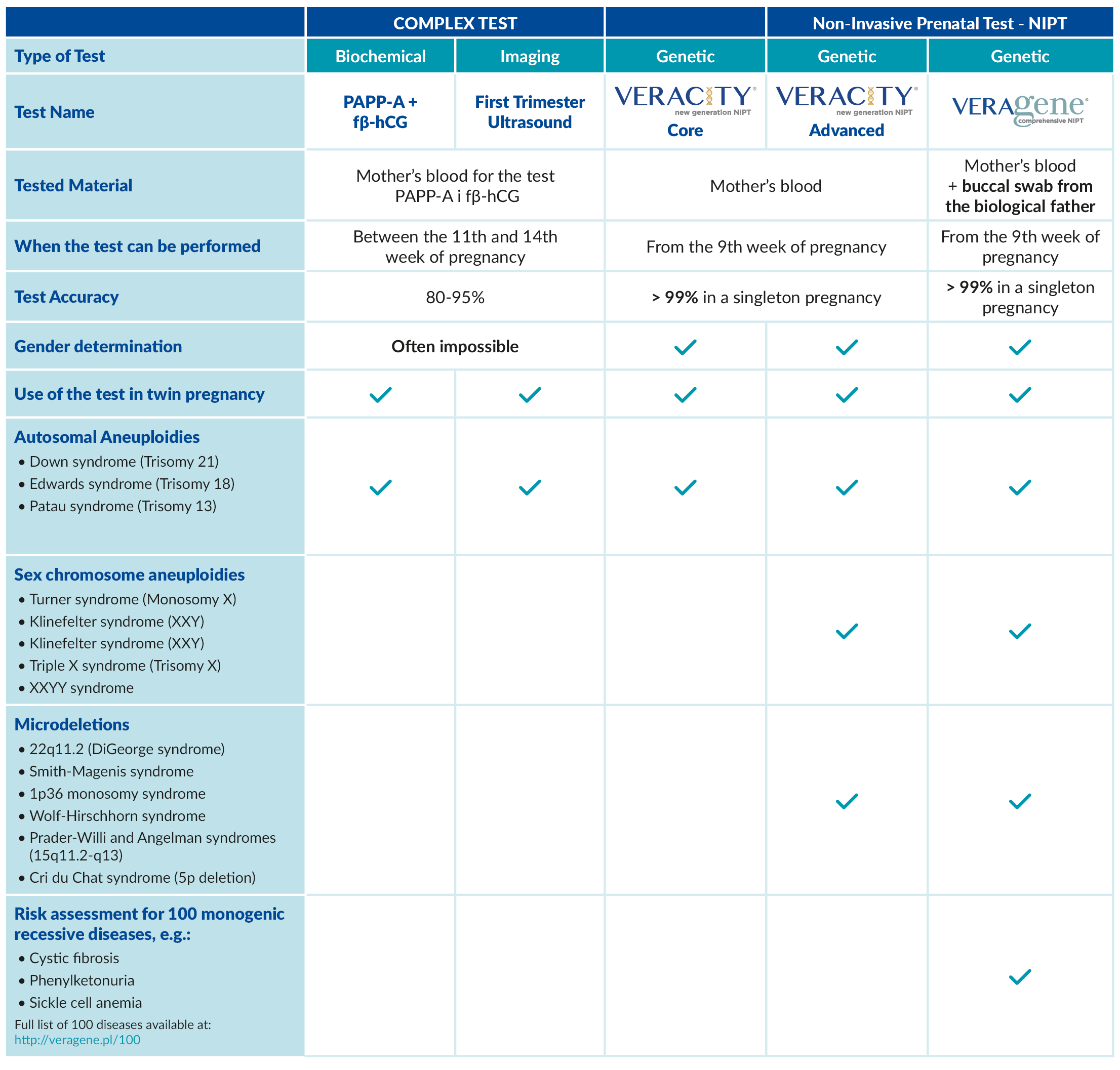
What is the new generation prenatal test VERAgene?
VERAgene is performed using a blood sample from the mother and a buccal swab from the biological father. The blood sample contains extracellular DNA from both the mother and the fetus. This DNA undergoes isolation and analysis along with the father's DNA sample for potential genetic mutations using next-generation sequencing. Complex bioinformatics algorithms are used to calculate the likelihood of a monogenic disease in the fetus.
The test results are sent to the doctor, who then passes the information on to the parents, providing them with the necessary support. In most cases, the test result is negative - indicating a very high probability of giving birth to a healthy baby.
Familiarize yourself with the process of performing the test. If you have questions about the test or genetic defects and how to identify them, ask your attending physician or the midwife caring for you. Medical personnel will illuminate your doubts and help you decide about the test.
Important information:
- The test can be performed in women from the 9th week of pregnancy. A referral from a doctor is not required.
- You are welcome to come to the intake with an ID card or other document proving your identity.
- A woman taking the test does not need to be fasting.
- The man (biological father) 1 hour before the test should not eat, drink, smoke, brush his teeth or chew gum.
- You will know the result after 7-10 working days. The result is sent to the indicated e-mail address.
- To discuss the result, we encourage you to consult a gynecologist.
Why take the VERAgene test?
Taking the test has many benefits. It is worth knowing that:
- The test is completely safe and non-invasive. It does not affect the course of pregnancy.
- The test has the broadest diagnostic spectrum - it is the only one on the market to detect the risk of monogenic diseases.
- The test is characterized by high accuracy:
- more than 99% for trisomies 21, 18 and 13, sex chromosome aneuploidies and microdeletions;
- more than 99% positive predictive value in detecting single-gene diseases.
- It is the only test on the market comparing genetic material from the father.
- The test can be performed as early as after the 10th week of pregnancy.
- You will know the result after about 7-9 working days.
A negative result of the test reassures parents and allows them to go through the pregnancy without anxiety about whether the baby will be born healthy.
A positive test result allows you to plan the next steps and ensure that the parents and the newborn receive proper care from the first moments of life.
If a high-risk result is received, we provide free consultation with a clinical geneticist and psychologist.
Others also bought

VERACITY is a next-generation non-invasive prenatal test (NIPT) that accurately detects common chromosomal abnormalities.

Ultrasound scan in pregnancy is used to confirm the pregnancy and assess the development of the foetus.

Massage for pregnant women has a relaxing effect, relieves pain and reduces swelling. It is best to apply for it during the second trimester of pregnancy.