 1000 tests and services
 544 doctors
 1500 visits available
- Damian
- Diagnostic Tests
- Diagnosis of organs and symptoms
- Gender-related
- Single-layer cytology + HPV28 DNA
Single-layer cytology + HPV28 DNA
Liquid-based cytology (LBC) detects about 64% more high-risk abnormalities than a traditional Pap smear. Expanding the test to include a screening for 28 types of HPV allows for early detection and identification of the specific virus type that may lead to cervical cancer. This is crucial for assessing cancer risk and offers a chance for complete recovery.
Warszawa
Any hours
Any facility
Any specialist
LBC + HPV-28 Genotyping is a comprehensive screening test that combines the modern LBC method with expanded HPV genotyping, covering 28 types of the virus. This advanced approach allows doctors to accurately determine the type of infection and assess the risk of cervical cancer.
HPV types covered by the test:
- 19 high-risk types with higher oncogenic potential, i.e. indicating a high risk of developing cervical cancer: 16, 18, 26, 31, 33, 35, 39, 45, 51, 52, 53, 56, 58, 59, 66, 68, 69, 73, 82;
- 9 low-risk types with lower oncogenic potential, i.e. causing benign lesions, such as warts on the skin and mucosal surfaces (mainly genital warts, i.e. condylomata acuminata) or recurrent laryngeal papillomatosis: 6, 11, 40, 42, 43, 44, 54, 61, 70.
By including both high- and low-risk HPVs, the test provides a more comprehensive assessment of the risk of developing cervical cancer and various non-malignant lesions. Meanwhile, liquid-based cytology ensures accurate sample collection and precise analysis of cellular material, minimising the risk of misdiagnosis.
Who is this test for?
The LBC + HPV-28 Genotyping test is particularly recommended for patients at risk of HPV infection, including women who:
- Became sexually active at an early age;
- Have had multiple partners;
- Smoke or have smoked;
- Use or have used hormonal contraception;
- Have a weakened immune system (due to HIV infection or certain medications);
- Have given birth more than once;
- Have genital herpes (caused by the HSV-2 virus);
- Have a family history of cancer. The test is also recommended for patients who want a detailed assessment of their health status with regard to HPV infections, neoplastic and dermatological lesions.
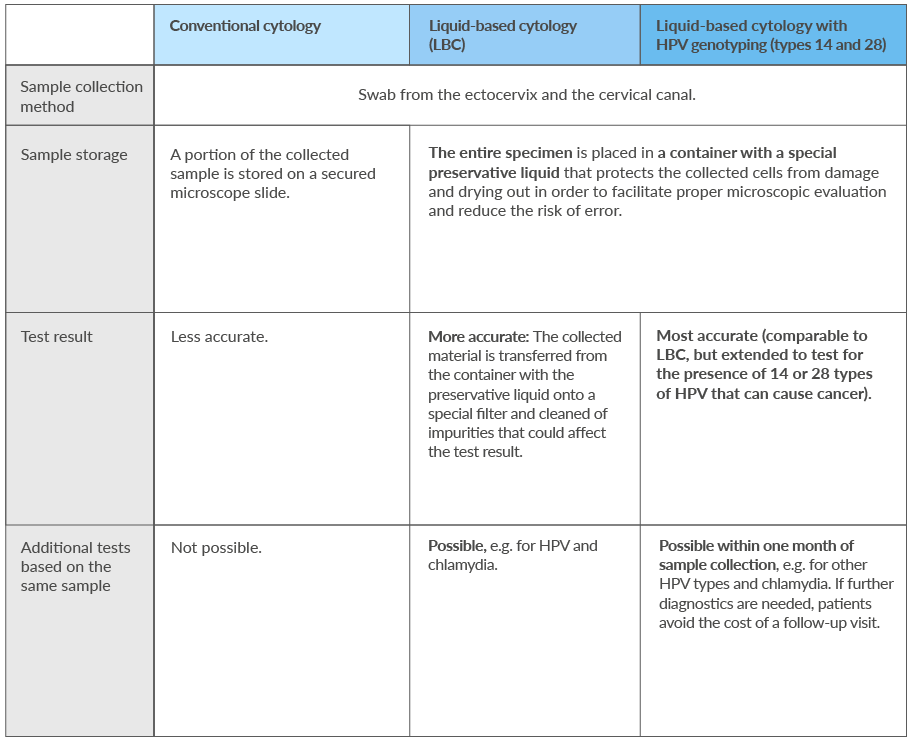
4 types of cytology – comparison
Click HERE to enlarge the table.
Purchasing process
- Please select a city and a medical centre where you want to have an LBC examination performed.
Please note: On the day of the test, please report to the reception desk of a Medicover Centre 15 minutes in advance.
If the test results are normal, we will inform you via SMS that you may collect your results:
- you can pick them up in person at Medicover where the test was performed;
- you can check them out at Medicover OnLine if you have a Medicover subscription.
If the results show any irregularities, our midwife will contact you by phone and offer you consultation with a gynaecologist at Medicover. If you do not have a Medicover subscription, you will be charged for the consultation.
If it is not possible to contact the patient, the results will be sent to her by standard mail with confirmation of delivery.
Liquid-based cytology (LBC) is an alternative to conventional cytology. It is a modern and, above all, precise method of screening for cancer.
A brush with the collected material is in the first place transferred to a container filled with a proper fixative fluid, and then sent to a laboratory. Only in the laboratory, the suspension from the test tube is applied to the glass slide to obtain one layer of cells. In conventional cytology, the collected sample is transferred to the microscope slide while still in the doctor's office, right after collection. Liquid-based cytology allows for filtering out the impurities (e.g. blood, mucus, inflammatory cells) from preparation. Such impurities may hinder the assessment of cervical cells.
Placing the collected sample quickly in the fixative fluid prevents it from drying out. Additionally, it reduces the risk of errors in microscopic assessment due to inadequate fixation of the preparation. This makes it easier to find abnormalities.
Liquid-based cytology provides more cells for assessment than conventional cytology. This way it improves the quality of the smear assessment and reduces the number of false-negative results.
In countries where liquid-based cytology is already widely used, the percentage of incorrect samples and inconclusive results has decreased.
One of the factors that increase the risk of developing cervical cancer is chronic HPV ("human papillomavirus") infection. The genetic material of this virus has been observed in many neoplastic tumours of cervical cancer. So far, about 200 types of this virus have been discovered. Only some of them are high-oncogenic, i.e. particularly contributory to the development of cervical cancer. The others do not increase this risk (they are low-oncogenic), but they can cause the so-called viral warts. Extending the cytological test with HPV genotyping makes it possible to check whether the cells of the cervix are currently infected with HPV and with what type of the virus.
Contraindications for the examination:
Note that samples for the test cannot be collected during menstruation.
Test procedure:
- The sample collection for examination is performed on a gynaecological chair.
- It involves inserting a speculum into the vagina and collecting a sample of the exfoliated cervical epithelium. This procedure is virtually painless, although patients may feel mild discomfort.
- The entire test, including the preparation, takes just a couple of minutes.
How to prepare for sample collection:
- Sample collection for liquid-based cytology resembles a standard cytological test and requires a patient to be appropriately prepared. Instructions on how to prepare for the cytology are included in the documents tab.